Wedding Envelope Addressing: Etiquette and Organization
How to Address Wedding Invitation Envelopes
Your wedding invitations are so much more than paper: they’re the very first glimpse your guests get of your celebration. And before anyone sees your invitation, they see the envelope. The names and addresses on the front are what make each one personal, and getting them right sets the tone for everything inside.
Of course, that’s exactly why so many brides stress about this step. You want to be respectful, you don’t want to accidentally offend anyone with a missed title or overlooked plus-one, and you definitely don’t want to spend hours second-guessing every line. What you need is a clear guide: something that helps you organize your addresses quickly and accurately while still following proper etiquette.
Keep reading for a free Wedding Guest List Toolkit you can download to keep everything neat, consistent, and ready for addressing.

This post is part of The Wedding Stationery Guide: a series of blog posts covering wedding invitation wording, timing, etiquette, and resources for your stationery suite.
The Basics of Wedding Envelope Addressing
Invitation suites include an outer mailing envelope, an optional inner envelope, and an envelope for guests to return their reply card.
Some of this etiquette advice may seem old-fashioned, but if you’re a bride who embraces traditions, be sure to follow these tips. When in doubt, I refer to Emily Post and Crane’s Blue Book for all things etiquette. That being said, it’s your wedding so make sure to do what makes sense for you!

1. MAILING ENVELOPE (OUTER)
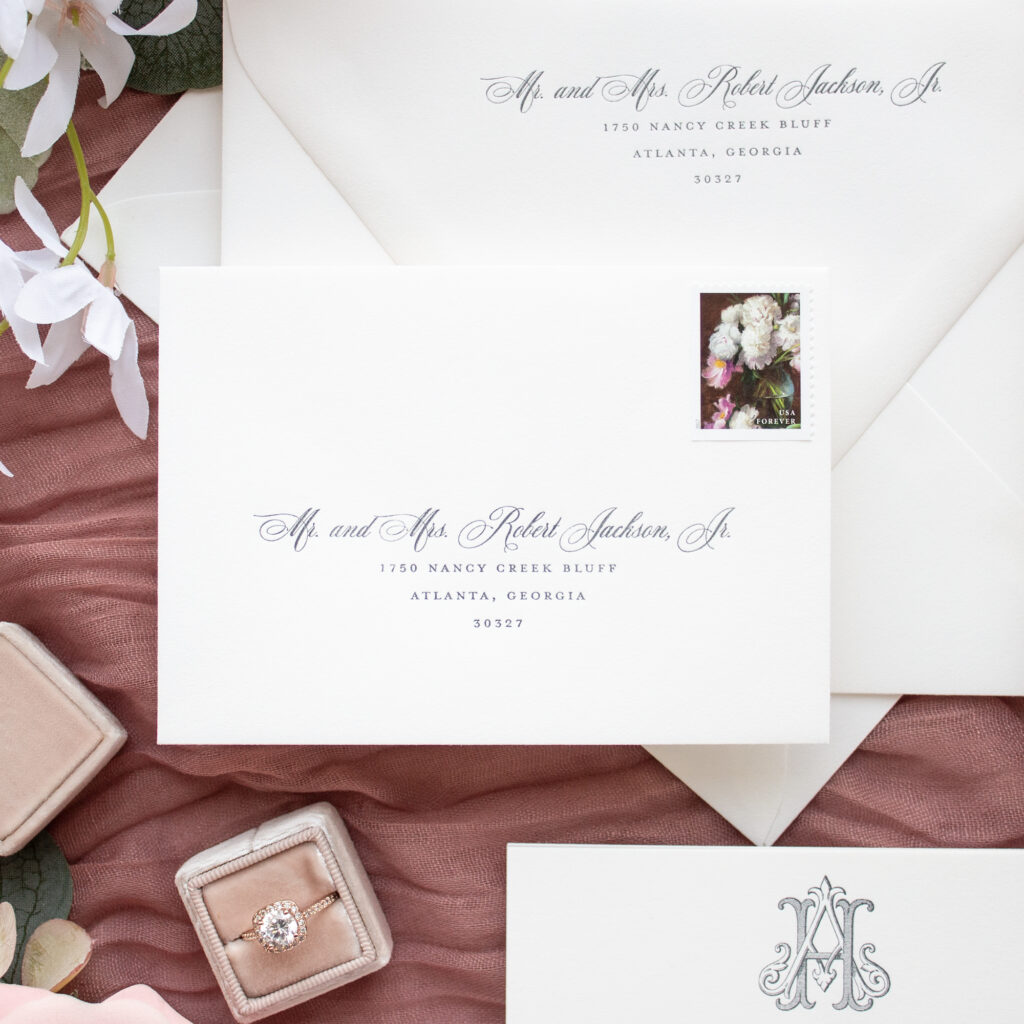
The outer mailing envelope is addressed with your guests’ full names and titles.
Mr. and Mrs. Clark Gable
Include your return address on the back flap of the envelope. You do not need to include a name on the return address.
Traditionally, you’ll use the hosts’ address for the return address and RSVP envelope address. However, it is common to for the RSVP envelope to be addressed to the bride or wedding planner.
2. RSVP ENVELOPE
The RSVP envelope should be pre-addressed and stamped. According to USPS addressing guidelines, there must be a name on the mailing address for the RSVP envelope.
3. INNER ENVELOPE (OPTIONAL)
If you’re using an inner envelope, it’s addressed a little differently than the outer envelope. Generally, you use the titles and surnames only.
Mr. and Mrs. Gable
You can use familiar names and titles for close family members.
Aunt Kathy or Grandmama
Formal vs. Informal Invitation Addressing Styles
The formality of your wedding should guide the way you address your envelopes.
- Formal weddings: Titles spelled out (Mr., Mrs., Doctor) and addresses written fully (“Street” instead of “St.”).
- Casual weddings: A more relaxed approach is fine, think first names only or abbreviations.
Quick tip: while consistency with all the addresses is a good idea, sometimes it’s okay to change things up! If you want to address your grandmother’s envelope using traditional etiquette, but keep it more casual for your college roommate, you’re the only one who will know 😉
Start with an organized guest list
Here’s the secret: beautiful, accurate envelope addressing starts long before the ink hits the envelope. It begins with a well-organized guest list.
Your guest list isn’t just names: it’s titles, mailing addresses, plus-ones, and sometimes kids. Without an organized system, it’s easy to end up with mismatched titles, missing zip codes, or forgetting who gets a plus one.
That’s where my Wedding Guest List Toolkit comes in. You’ll get a simple spreadsheet designed to track all the details in one place AND bonus addressing etiquette tips.
Traditional Invitation Addressing Etiquette Tips
Spell it out
– Address an invitation using a guest’s full names – no nicknames, initials, or abbreviations. That means you need to ask your co-worker Eddie if his full name is Edward or Edwin.
– Spell out street names and cardinal directions: Road, Boulevard, Court, Circle, North, South
– Write out the full state name instead of using the two letter postal abbreviation: Michigan, not MI
– Spell out single digit street numbers or numeric street names under 100: One Royalton Boulevard or Thirty-First Street or 202nd Avenue
Caveats to this rule are titles (Mr. Mrs. Ms.) and suffixes (Jr. or Sr. or III).
If you want to spell out the suffix, make sure to include a comma before like this:
Mr. Robert Ginter, junior


Include the names of everyone who is invited
– Use both names for married couples
– List both names for established couples that aren’t married
– Use “and guest” if you’re letting them bring a plus-one
– List all invited children’s names (either on the second line of the mailing envelope, or on the inner envelope if you’re using one)
Use Titles, Suffixes, and honorifics
Titles like Mr. and Mrs., or suffixes like jr. and III should be included.
If a guest has an earned title, like Doctor or a military ranking, make sure you include it with their name. The person with the highest ranking is listed first on the envelope, regardless of gender.
Other details to keep in mind
The return address
Traditionally, the return address is printed on the back flap of the outer envelope.
RSVP envelopes are printed with the same name and address, centered on the front of the envelopes. If they want, guests can handwrite in their return address.
When to finalize your guest list
If you order from Banter & Charm, your address spreadsheet will be due about two weeks before approval. So it doesn’t have to be finished before you order, but in my experience it always takes longer to gather your addresses than you might expect.
International mail
International addresses may follow different formatting, and they often require additional postage. Double-check your guest list early if you’ll be mailing invitations overseas.
WEDDING ENVELOPE ADDRESSING FAQs
How do you include the wife’s name on an envelope?
You can write out the full names and titles of both people:
Mr. Alexander Browning and Mrs. Abigail Browning
Or drop the titles and use the less formal: Alexander and Abigail Browning.
Who gets which titles (Mr., Mrs., Ms., etc)?
- Men are traditionally addressed as Mr.
- Married women are addressed as Mrs. with their husband’s name, unless you know she prefers her own first name or the title Ms.
- Single or divorced women are usually addressed as Ms.
- Widows may still prefer Mrs. with their late husband’s name (if you’re unsure, ask).
- Children under 18 typically don’t receive titles. Their names are listed on the envelope beneath their parents’ names.
Whose return address should we use, and what names go there?
Traditionally the host’s return address is used (generally the bride’s parents). The hosts’ names can be left off the return address if you prefer, but RSVP envelopes must include a name with the address.
How do we list children on an invitation envelope?
Children’s names can be written on a second line below the parents’ names. If you’re using an inner envelope, list children’s names on the second line of the inner envelope.
Our older relatives are sticklers for tradition, but our friends are more modern. Which addressing format should we use?
Use traditional etiquette for your older relatives, and keep it modern for your friends. Chances are, no one will be comparing their envelopes.
What if I’m not sure about someone’s preferred title?
Your best bet is to reach out to the person. It may feel awkward, but they’ll appreciate that you took the time to ask.
Going with the most traditional etiquette is generally the best if you’re not able to verify.
Can we send adult roommates a shared invitation?
Traditionally, anyone over 18 should receive their own invitation.

WRAPPING IT UP
With your guest list organized and a few etiquette basics in hand, you don’t have to lose sleep over envelope addressing. You’ll be able to put your addresses together quickly, follow the right etiquette, and send invitations that feel both thoughtful and polished without the second-guessing.
And if you’d rather not think about envelopes at all? I offer addressing (printing or hand calligraphy) with all Banter & Charm orders so your suite arrives polished, coordinated, and stress-free.

request a quote
For pricing and to get started, schedule a free consultation.
Let’s transform your wedding invitation vision into a tangible, beautiful reality.
Ready to begin?
See some of this pretty paper in person with a sample pack.


